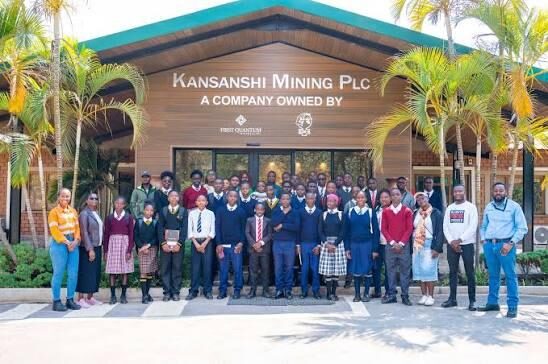
For hundreds of young people in North-Western Province, the Kwambula Training Centre has become more than just a technical institution; it has become a gateway to opportunity, employment and a brighter future. Since its establishment in 2012 through a partnership between Kansanshi Mining PLC, the Technical Education, Vocational and Entrepreneurship Training Authority (TEVETA) and the Government of Zambia, the centre has been equipping young Zambians with world-class technical skills while ensuring that host communities benefit directly from mining investments.
This commitment was once again brought into focus during the inaugural Kwambula National Skills Competition in Solwezi, where government officials, industry leaders and technical institutions gathered to celebrate excellence in vocational training and the growing impact the programme is having on Zambia’s industrial workforce.
Speaking during the event, Kwambula Training Centre Lead Webby Makoloni said the programme was intentionally designed to create opportunities for young people from communities surrounding First Quantum Minerals’ operations while also attracting talent from across the country. Since 2012, First Quantum Minerals has invested more than US$1.5 million annually in the fully funded learnership programme, which has so far supported 760 trainees, with 512 graduates already completing their training while 248 learners remain in various stages of the programme.
Importantly, the selection process deliberately prioritises local participation. Makoloni said 65 percent of trainees are drawn from North-Western Province, particularly host communities, while the remaining 35 percent come from the rest of Zambia, ensuring that the benefits of the programme are first felt by local families living alongside the mining operations.
The approach has created life-changing opportunities for school leavers, displaced community members and unemployed youths who might otherwise have struggled to access specialised technical training. “Our commitment is to transform lives by providing young Zambians with access to quality technical training, practical experience and meaningful career opportunities,” Makoloni said. He explained that the name Kwambula, a Kaonde word meaning “igniting hope,” reflects the institution’s mission of empowering young people with skills that can lift families out of poverty while contributing to national development.
Beyond the classroom, the centre has become an important contributor to the local economy by producing artisans equipped to work in mining, construction, manufacturing and other industrial sectors. Its three-year training model combines classroom learning with practical workshop instruction and workplace experience, ensuring graduates leave with both theoretical knowledge and hands-on industry skills that employers demand.
The programme is also breaking barriers by encouraging greater participation of women in technical careers traditionally dominated by men. According to Mr Makoloni, 145 female trainees have graduated from the programme, representing approximately 28 percent of all graduates, a milestone that demonstrates the centre’s commitment to gender inclusion in engineering and industrial trades. The inaugural Kwambula National Skills Competition further showcased the calibre of training taking place at the centre, bringing together trainees from institutions across Zambia to compete in Auto Electrical, Power Electrical, Heavy Equipment Repair, Instrumentation, Metal Fabrication, Rigging and Mechanical Fitting.
The competition also served as a selection platform for competitors who will represent Zambia at the WorldSkills Africa Competition later this year in Algeria. Engineering Institution of Zambia Registrar Engineer David Kamungu described the competition as a strategic investment in Zambia’s future workforce, saying skilled technicians and artisans remain essential to the country’s industrialisation agenda.
He said while engineers design infrastructure and industrial systems, it is technicians, technologists and craftspeople who transform those designs into reality through their practical expertise. “This competition represents much more than a contest. It is an investment in Zambia’s future workforce and demonstrates that technical and vocational education is a strategic pillar for industrialisation, innovation and sustainable development,” he said.
Speaking on behalf of Kansanshi Mining PLC, Assistant General Manager Axel Kottgen, Kansanshi Foundation Manager Simon Keevil said the company’s investment in Kwambula reflects its long-term commitment to developing local talent rather than relying solely on imported skills. “When Kansanshi invested in establishing and expanding the Kwambula Learnership Programme alongside TEVETA, our vision was clear, we wanted to build a world-class training ground right here in Solwezi that turns passionate local talent into globally competitive craftspeople,” he said.
Keevil noted that modern mining depends not only on advanced machinery but on highly skilled people capable of operating, maintaining and improving complex equipment safely and efficiently. He said the competition demonstrated that young people from North-Western Province possess the talent, discipline and technical ability to compete alongside the best in the country and beyond.
And, North-Western Province Deputy Permanent Secretary Luckson Mulumbi emphasized that while global investments in mining, infrastructure, and agriculture have fuelled two decades of rapid growth in Solwezi and surrounding districts, it is skilled Zambian artisans and technicians who turn capital investments into sustainable local development.
The Deputy Permanent Secretary praised the tripartite operational model linking the Government of Zambia, TEVETA, and First Quantum Minerals (FQM) through the Kwambula Training Centre. “When government and the private sector work together within a peaceful business environment, the benefits extend far beyond the workplace,” Mulumbi noted.
“We see families experiencing improved livelihoods, local businesses growing, communities prospering, and the province becoming increasingly competitive.” He further expressed strong government approval regarding the growing participation of young women entering industrial trades traditionally dominated by men, such as heavy machinery repair, electrical systems, and structural fabrication. “Together, we are proving that the future of North-Western Province will not be defined solely by the resources beneath our soil, but by the knowledge, skills, innovation, and determination of our people,” Mulumbi concluded.
Meanwhile, the Kwambula trainees claimed top honours in almost every discipline, underlining the effectiveness of the institution’s practical, industry-driven training model. In Power Electrical, Joyce Kamboyi of Kwambula Trades Training Institute emerged champion with an outstanding score of 98 percent, ahead of competitors from Solwezi Trades, NORTEC, Sino-Zam Vocational College, Luanshya Technical and Business College, Lukashya Trades, Mansa Trades and Kitwe Trades School.
Kwambula also swept the Instrumentation category, where Pascalina Kasumpa secured first place with 95 percent, while Kelvin Lwando won the Heavy Equipment Repair (HER) competition after scoring 86 percent. In Metal Fabrication, Precious Mwila Nsama claimed first place with 93 percent, followed by fellow Kwambula trainee Blessing Chilongo in second place, demonstrating the institution’s depth of talent in fabrication and welding disciplines.
The dominance continued in Mechanical Fitting and Machining, where McMillan Chapesha took first place with 90 percent, while teammate Cavin Munshya finished second with 88 percent, leaving competitors from Sino-Zam, NORTEC and Kitwe Trades School trailing behind. Kwambula trainees also excelled in Rigging, where Kamiza Jack, Manfwela Grian and Chifita Leonard jointly shared first position after each scoring 92 percent, ahead of teams from Sino-Zam College of Science and Technology and Kitwe Trades School.
The competition attracted participants from leading technical institutions across Zambia, including NORTEC, Solwezi Trades Training Institute, Sino-Zam Vocational College of Science and Technology, Luanshya Technical and Business College, Kitwe Trades School, Kabwe Institute of Technology, Lusaka Vocational and Technical College and Mansa Trades, highlighting the national significance of the event.